

一 | BANGKOK -- Zhang Hongliang, a former restaurant manager in central China, took various gigs in and outside China to support his family after losing his job during the COVID-19 pandemic.In March, a job offer to teach Chinese cooking at a restaurant led him into a cyber scam compound in Myanmar, where he was instead ordered to lure Chinese into giving up their savings for fake investment schemes via social media platforms.Zhang is one of tens of thousands of people, mostly but not all Chinese, who have become ensnared in cyber scam networks run by powerful Chinese criminal syndicates in Southeast Asia. Regional and Chinese authorities have netted thousands of people in a crackdown, but experts say they are failing to root out the local elites and criminal networks that are bound to keep running the schemes.When scam operations are shut down in one place they often just resurface elsewhere. The problem is an embarrassment for Beijing and is discouraging ordinary Chinese from traveling to Southeast Asia out of fear they might be duped or kidnapped and caught up in a cyber scam operation. In recent years, media reports have uncovered instances of young people being lured to places in Cambodia or Myanmar for high-paying jobs, only to be forced to work as scammers. Rescue organizations say people are regularly beaten or face physical punishments such as being forced to run laps if they don't perform well. In August, China, Thailand, Laos and Myanmar agreed to set up a joint police operations center to tackle cyber scams in the region. On Oct. 10, China’s Ministry of Public Security announced that its “Summer Operation” had successfully brought back 2,317 scam suspects from northern Myanmar to China.China calls such people suspects, though experts say most of them are victims who were forced to work for the criminals. They question how they will be treated once back in China. The schemes based in countries like Myanmar, Laos and Cambodia are run by Chinese bosses hand-in-hand with local elites. Many are based in places where China has financed big construction projects through leader Xi Jinping’s signature Belt and Road Initiative.Myanmar's border regions long have been a magnet for criminals — historically including drug producers and traffickers — because of lax law enforcement. Such places are generally under the control of ethnic minority armed groups, either opposed to or allied with Myanmar’s central government. Some also cooperate with organized crime gangs.“From the vantage point of the Chinese government, it’s a source of extreme embarrassment that you have so many of these Chinese criminals operating all across Southeast Asia,” said Jason Tower, an expert on transnational crime with the United States Institute of Peace.The syndicates also are known for “pig butchering” cons, where scammers entice individuals, often halfway across the world, to invest their money in bogus schemes after duping them into digital romances.The scammers divide their targets into two categories: Chinese and non-Chinese. They use scripts, images of models and influencers and translation software to trick the people they contact by phone or online into parting with their money. Victims can be anywhere in the world.The criminals have “ridden on the shoulders of the Belt and Road Initiative,” said Tower, who outlined links between the criminals and Chinese state enterprises, think tanks and government officials in a 2020 report written for the United States Institute of Peace.Zhang was working in Thailand and on a visa run to Laos when he met the man who lured him to the scam compound in Myanmar. Giving what he said was his last name, Gao, he claimed to be a broker and travel agent for Chinese living in Thailand. Zhang and his wife wanted extra money to pay for in vitro fertilization to have another child. Gao suggested he go work in Myawaddy, in eastern Myanmar’s Kayin state, teaching a local chef how to cook Chinese dishes in Gao’s new restaurant. The pay would be double what Zhang made in China.Zhang was wary. Since a 2021 coup, military-controlled Myanmar has been embroiled in civil conflict. But Gao reassured him that he wouldn’t be doing anything illegal and said the restaurant would have plenty of customers since many cyber scam businesses were operating in the area.That might have raised a red flag but it was only once he got to Myanmar that Zhang realized his predicament. He asked to go back home, saying there was a family emergency. His family helped him scrape together some 40,000 yuan ($5,472) to pay off the debt Gao claimed he owed him, and he slipped away one night, swimming across the Moei River into Thailand, where he turned himself in to Thai police, who contacted the Chinese Embassy.Zhang showed the AP copies of his deportation notice from the Thai Immigration police and a temporary ID card. He returned to China in late June and was questioned by Chinese police but not detained. He has been sharing his story on Douyin, the Chinese version of TikTok, to alert others to the risks and says people often contact him about relatives trapped in cyber scam compounds.“We all went out with this wonderful sense of hope, but then reality slammed us in the face,” he said.In total, China has detained some 4,000 suspects and returned them back to China. The Ministry of Public Security has claimed “breakthrough results” through operations in coordination with Myanmar authorities. On Monday, they announced they had repatriated another 2,349 people. The ministry did not respond to a faxed request for comment.One 31-year old former chef who was smuggled into Myanmar’s Wa State earlier this year said he saw his company hand over four people to Chinese police with little fanfare in September. Other companies did the same, said the man, who was smuggled into Myanmar and later rescued by a non-profit organization. He declined to be named out of fear of government retribution, and The Associated Press could not independently verify his account.Overall, the enforcement actions don’t seem very comprehensive, experts say. The groups now based in Myanmar originally were located in Cambodia. When Cambodia cracked down on online gambling rings and illegal casinos in 2019, many of the groups just moved to less well policed places in Myanmar. Some were taken over by rival gangs.China's efforts to repair its image have so far not made much headway, said Thitinan Pongsudhirak, a professor of political science at Thailand’s Chulalongkorn University. “You can crack down on these symptoms and the manifestations … that you can see in the borderland areas," he said, "but they’ll come back unless you really have a sustained effort." -—-AP researcher Wanqing Chen in Beijing and AP writers Grant Peck and Jintamas Saksornchai in Bangkok contributed to this report.。 美国财政部长贝森特上周宣布将通过扩大长债回购来压低美国融资成本,这一突如其来的计划虽然引发了关于其最终成效的激烈辩论,但关键的市场指标与机构持仓数据却似乎表明,该举措已开始初步显现成效。 数据显示,自贝森特上周宣布该计划以来,美国国债的表现已超越同期限利率互换,30年期的两者利差缩窄至了今年2月以来的最低水平。基准美债收益率在美国财政部宣布将长期债券回购规模“至少翻倍”后,经历了最初的剧烈波动,随后呈现震荡走低态势。

二 | 花旗集团美国利率策略主管Jason Williams表示,“这种全新的财政部‘看跌期权’为市场提供了潜在的政策背书,从而改善了持有长端国债的风控不对称性。

三 | 贝森特最近的一系列举措——包括增加回购规模以及干预日元汇率,无不表明他正准备不惜一切代价来实现其既定目标。” 周一,美国媒体报道称,美国财政部可能会动用其存放在美联储的现金——即财政部一般账户(TGA)——来为这笔扩大的长期国债购买计划提供资金支持。

四 | 这一消息进一步提振了市场情绪,而国际原油价格的回落,也同步为债市提供了上涨动力。

五 | 尽管长期融资成本仍徘徊在多年高位,且推动全球收益率上行的诸多结构性因素依然未变,但市场近期走势表明,若非贝森特的干预,收益率本会更高。 即便这项扩大的回购计划长期效果仍存疑虑——例如贝森特“恩师”、亿万富翁投资者德鲁肯米勒等权威人士便公开批评贝森特的干预是一个错误——但众多交易员已清晰意识到市场上出现了一位“强力买家”,因而普遍不愿贸然站在“贝森特看跌期权”的对立面。

六 | 期权市场也呈现出类似的主题——过去一周市场呈现出明显的看涨倾向,这表现为追踪长期美债的国债期货看涨期权持仓量相较于看跌期权急剧攀升。

七 | 相比之下,较短期限美债期货的波动率偏度(skews)则继续维持在过去几个月普遍处于的中性水平附近。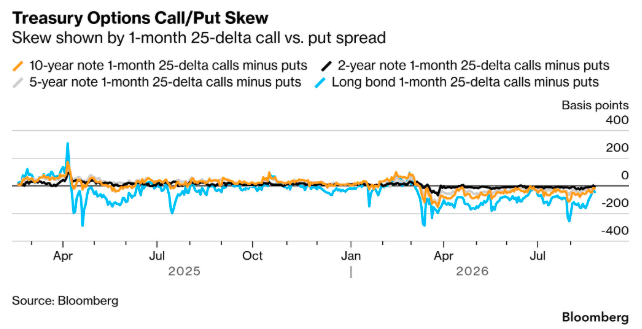 “当前的‘操作’集中在长端,而市场目前的担忧——如果可以这么说的话——是长债收益率可能会因干预而暴跌,”R.J. OBrien & Associates的衍生品经纪人Alex Manzara分析道。

八 | 利率互换是一种常见的衍生品合约,交易双方约定交换未来的利息现金流,通常是以浮动利率交换固定利率。企业和机构投资者常利用它来规避利率风险,例如将其支付端与未来的负债进行匹配。在美国,这类合约通常与有担保隔夜融资利率(SOFR)挂钩,其中30年期互换利率精准反映了市场对未来三十年平均利率水平的预期——这使其成为一种在金融属性上与30年期美国国债高度对标的产品。 近年来,随着全球政府债券供给量急剧膨胀,美债收益率与互换利率之间的分化急剧扩大。这种利差走势吸引了大量对冲基金入场做空或做多互换利差。美联储研究人员估算,对冲基金在这类策略上的持仓规模已从2022年的不足500亿美元飙升至去年的创纪录水平——3050亿美元。 尽管目前30年期美国国债收益率仍远高于互换利率,但贝森特的表态已带来了一定程度的边际修复。10年期互换利差同步迎来收窄,两者间距缩窄了3个基点,降至约38个基点。 ING Groep NV纽约地区研究主管Padhraic Garvey表示,互换利差的收窄充分反映了市场对“只要财政部认为政策合适,未来完全可能一而再、再而三地追加回购”这一预期。 当然,客观来看,近期长债收益率的回落,还仅能算是对长期美债融资成本多年来的攀升态势构成的微幅修正。被贝森特点名作为特朗普政府重点调控目标的10年期美债收益率目前仍交易在4.6%上方,接近2025年初以来的最高水平;30年期美债收益率则维持在5.2%附近,距离2007年以来的历史高位仅一步之遥。

九 | Pimco公共政策主管Libby Cantrill总结道:“虽然在收益率曲线长端实施回购能在技术上压低收益率,但导致美债收益率居高不下的根本性矛盾——尤其是美国结构性预算赤字的显著增加,这需要大量国债供应来为美国债务提供资金——在短期内根本无法改变。” (文章来源:财联社)。

十 |
Current article:http://qingfanceliangsangniang.cfd/news/20260826_880.html
Published on:11:04:21