情牵两世
梨花声音研修院的声乐课为何能让银发学员听得懂?_我的网站

一 |

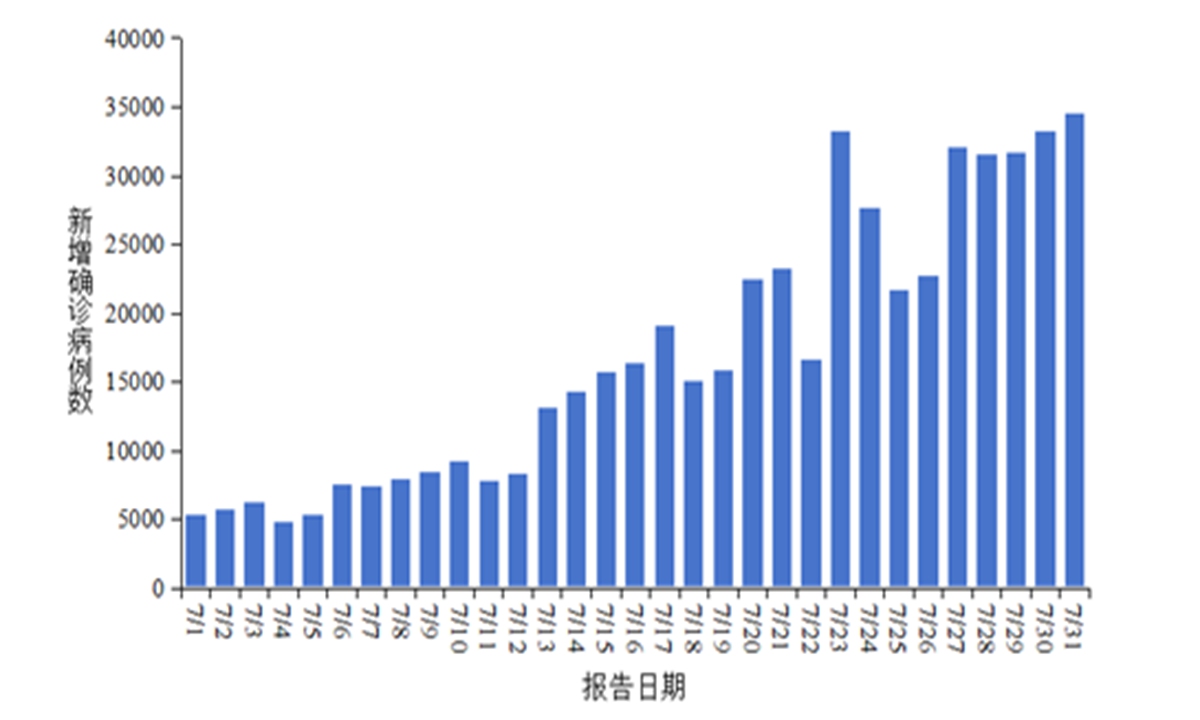
China reported 522,000 newly confirmed COVID-19 cases in July, including 487 severe cases and one related death with cases showing a fluctuating upward trend, China's national disease control authority said.
The current uptick in infections represents another regular cyclical wave, with its severity comparable to surges seen in the past two years. The upward growth curve has slowed markedly, and the country is now on the plateau phase of this epidemic peak, said the Chinese Center for Disease Control and Prevention (Chinese CDC) on Thursday.
All tested infection samples were confirmed to be the Omicron variant, with the NB.1.8.1 strain and its sublineages accounting for the majority of circulating cases, the Chinese CDC said.
A Beijing-based respiratory disease specialist told the Global Times that waning population immunity, continued virus mutations that weaken existing antibody protection, and increased summer travel have contributed to the recent modest rise in infections. However, there is no evidence that the virus has become more pathogenic. Nationwide infections appear to be nearing their peak and case numbers may begin falling in late August.
According to sentinel hospital surveillance data, from June 29-July 5 to July 27-August 2, the proportion of influenza-like illness among all outpatient and emergency visits at China's 1,041 COVID-19 and influenza sentinel hospitals edged up with slight fluctuations, standing at 4.3 percent, 4.4 percent, 4.5 percent, 4.4 percent and 4.5 percent, respectively.
During the same period, the COVID-19 positivity rate among patients with influenza-like illness in outpatient and emergency departments rose for consecutive weeks.
Several factors drove the fluctuating rise in COVID-19 cases in July. Population immunity has waned, as more than six months have passed since the last major wave of infections for most people, while continued SARS-CoV-2 mutations have reduced the protection provided by existing antibodies, Li Tongzeng, a respiratory disease medic from Beijing You An Hospital to the Capital Medical University, told the Global Times on Friday.
These factors, combined with increased travel and population mobility during the summer vacation, contributed to the recent small-scale surge. Based on patterns observed in recent years, COVID-19 infections tend to rise every six to eight months as population immunity declines, said Li.
The expert noted that while the virus continues to mutate, there is no evidence that it has become more pathogenic. Clinical data show that most patients develop only mild symptoms, with very few progressing to pneumonia or requiring hospitalization.
The Chinese CDC noted on Thursday that since COVID-19 was reclassified as a Category B infectious disease under Category B management, it has evolved into a prevalent, recurring respiratory infectious disease in China, with one to two epidemic fluctuations occurring nationwide each year.
Li also noted that residual immunity from previous infections also helps reduce disease severity, with most reinfections presenting as mild upper respiratory symptoms that resolve within about a week. The single COVID-related death reported nationwide in July further indicates that the current fatality rate remains very low.
Judging from historical epidemic patterns and current case growth trajectories, national infection figures may begin to decline in late August. Nationwide case numbers are now nearly at their peak, with declines already observed in some regions, said Li.
The Chinese CDC also said on Thursday that surveillance had not detected any variants posing major public health risks, nor had the current wave caused notable disruptions to the healthcare system.
The public is advised to take appropriate protective measures, including wearing masks when necessary, maintaining good personal hygiene, adopting healthy lifestyles and getting vaccinated as recommended.
。 “一个字定腔体”——课堂上,梨花声音研修院的声乐讲师让用户念一个“好”字,或者念“身正威武”,便能快速找到发声腔体的位置;用“小鸡啄米”的形象比喻,帮助用户找到高音的发力点。这是梨花声音研修院声乐课堂上的真实场景。不讲晦涩的专业术语,不用复杂的五线谱,用“大白话讲方法”、用“像对待小朋友般的耐心”去拥抱每一位乐龄用户。 这种“化繁为简”的教学方式,源于讲师自身的经历。

二 | 六年级患上鼻炎,13岁被检查出扁桃体肥大,艺考时又伴有声带小结——这些先天嗓音条件的“不完美”,后来反而成为最宝贵的教学资源。

三 | “我用自己的亲身经历告诉大家,这些问题都不足以阻挡热爱。”从线下到线上,从传统方式教学到适配乐龄群体,讲师的教学理念完成了一次深刻的蜕变:“起初可能会讲一些专业的术语,但是自从接触到乐龄用户,我改用具体可感的动作和意象,让他们快速找到发声腔体。用大白话的形式,让他们在一两分钟之内理解。” 在梨花声音研修院看来,“让每一位用户都被看见”是贯穿始终的信条。

四 | 面对有些用户可能存在的缺乏自信、不敢展示的情况,平台有一套独特的引导方法:先让用户试着唱一句记录下来,讲授方法后再让他们重唱同一句。前后对比,大部分人能够从中感受到自身的变化,进而收获自信。 在课程配置上,平台会根据每个用户的嗓音和实际情况推荐适合的歌曲——如果是女高音,盲目模仿原唱其实很难找到高音点,但找到适合她的个性化方式,上高音就有了更多方法。 一位60多岁的退休舞蹈老师,跟梨花声音研修院学习了四个多月声乐后,录制了一首属于自己的歌,后来还登上公司年庆舞台边唱边跳。“从前她只在舞蹈中找到自信,现在唱歌也给了她同样的快乐。

五 | ”讲起这件事时,讲师眼中闪着光。

六 | 在日常教学过程中,平台同样注重对乐龄用户情感上的陪伴。“教学是核心,但老年人不能长时间高负荷练习,唱一会儿就需要放松互动。

七 | ”课堂节奏张弛有度,这正是对乐龄群体学习特点的精准把握。 面向未来,梨花声音研修院有着更深远的思考维度——“让社会认同乐龄群体的价值”。在教授声乐的同时,平台也在向社会传递一个朴素的信念:岁月从不会磨灭一个人的价值,每一位老年人都值得被认真对待。 当一位学员从前只在舞蹈中找到自信,现在唱歌也给了她同样的快乐,这就是梨花声音研修院存在的意义——让每一位用户都找到属于自己的声音。【广告】免责声明:本内容为广告,相关素材由广告主提供,本文仅代表作者个人观点,与本网无关。本网发布目的在于传递更多信息,并不代表本网赞同其观点和对其真实性负责,广告内容仅供读者参考,请自行核实相关内容。

八 |
Current article:http://qingfanceliangsangniang.cfd/aqqm1n/6y7.html
Published on:19:52:17
 假装情侣
假装情侣 杀人回忆
杀人回忆 巨星秀
巨星秀 面对面
面对面 假扮女佣
假扮女佣 斗鱼
斗鱼 田径女神走红
 熊猫tv
熊猫tv


